 Collage: Paula Balondo; Source images: Courtesy of Allure editors and brandsSave this storySave this story
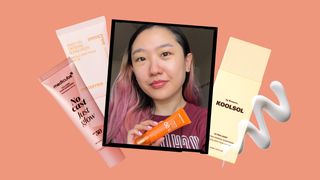
Don't get us started on the best Korean sunscreens. Wait, scratch that. Do get us started, but don't blame us as we ramble on for an hour. These K-beauty SPFs glide on like a dream, disappear without a trace, quench dehydrated skin, brighten dull complexions, and, of course, protect us against sun damage. Even with new regulations that ban the sale of sunscreens containing non-FDA-approved UV filters in the US (including Amazon, so be vigilant about fake listings!), we've still got a wide range of elegant, lightweight formulas to choose from, whether it's a fan-favorite from Innisfree or an under-the-radar brand like Koolsol by Knours.
Our Top Korean Sunscreens
- Best Chemical Sunscreen Overall: Mixsoon Bean Sunscreen SPF 50, $18
- Best Mineral Sunscreen Overall: Koolsol by Knours Ultra Light Invisible Mineral Sunscreen SPF 50, $25
- Best for Combination Skin: Manyo Air Light Moisturizing Sunscreen SPF 50, $18
- Best Plumping: Medicube No Cast Just Glow Collagen Sunscreen SPF 50, $22
Keep scrolling to learn what sets the best Korean sunscreens apart, thanks to wisdom from K-beauty experts, board-certified dermatologists, and Allure editors.
Editor's note: We're aware we only have one mineral sunscreen on this list—well, technically two, if you count a P.S. callout. We are actively testing more mineral formulations as they come out and will be sure to update this story as we discover ones worth recommending!
Frequently Asked QuestionsLargeChevron
- How are Korean sunscreens different from Western sunscreens?
- Are Korean sunscreens better than Western sunscreens?
- How should I choose a Korean sunscreen?
- Meet the experts
- How we test and review products
- Our staff and testers
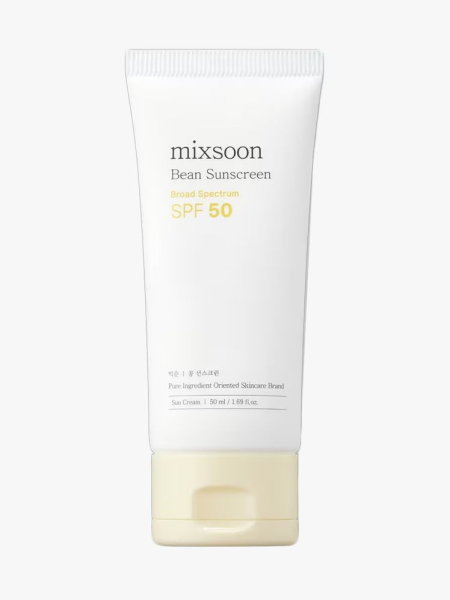
Best Chemical Sunscreen Overall: Mixsoon Bean Sunscreen SPF 50
 Save to wishlist
Mixsoon
Bean Sunscreen SPF 50
Amazon
Nordstrom
Ulta Beauty
Allure beauty director Sarah Kinonen applying the Mixsoon Bean Sunscreen SPF 50
Sarah Kinonen
Why we love it: When you like Mixsoon's Bean Essence as much as we do, it's, ahem, barley a surprise that we'd be equally obsessed with the Mixsoon Bean Sunscreen. Not only does it house an impressive SPF 50—this is pretty standard for Korean sunscreens, which is yet another reason to love them—but there's a host of hydration-boosting, soothing ingredients such as soybean ferment, barley seed, and panthenol to support your barrier. The finish is slightly dewy, but not overly so, and definitely not sticky. This chemical SPF checks all our boxes, and affordably so at under $20.
Tester feedback from beauty director Sarah Kinonen
LargeChevron
“As someone who has been testing sunscreens for most of her life (I’m a former Floridian), I’ve been around my fair share of lotions, sprays, and powders. But it wasn’t until about a decade ago that I actually started to enjoy applying them. I think it has less to do with the format and more to do with the actual formula. And my favorite formulas? Anything that comes from Korea. The textures are lightweight, easy to blend, and even easier to remove. They layer well and don’t sting my sensitive eyelids. Lately, I’ve been loving the Mixsoon Bean Sunscreen SPF 50. It’s got all of the above features, plus an impressive SPF 50 level. I love the finish, too. It leaves behind a slightly dewy, never-sticky effect that can be worn solo or under makeup. I even wear it when I work out—and it never bothers me or my sensitive eyelids! I love it!” —Sarah Kinonen, beauty director
More to know
LargeChevron
- Sunscreen type: chemical
- UV filters: avobenzone (3%), homosalate (7%), octisalate (5%), octocrylene (5%)
- Other noteworthy ingredients: soybean ferment, barley seed ferment, niacinamide, vitamin B5, vitamin E
- Who it's for: everyone
- Fragrance-free: yes
- Water-resistant: yes, up to 80 minutes
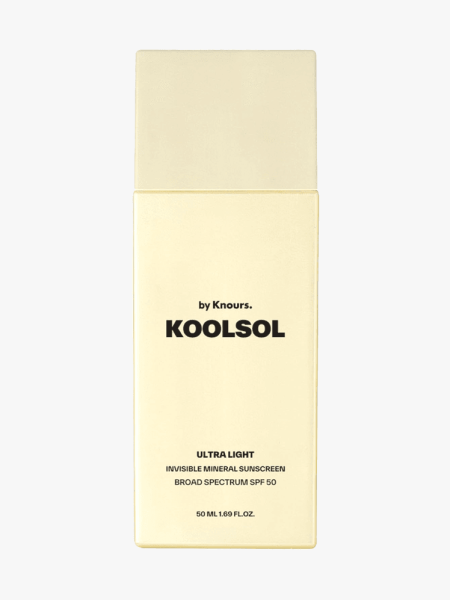
Best Mineral Sunscreen Overall: Koolsol by Knours Ultra Light Invisible Mineral Sunscreen SPF 50
 Save to wishlist
Koolsol by Knours
Ultra Light Invisible Mineral Sunscreen SPF 50
Amazon
Soko Glam
Why we love it: Mineral sunscreen gets a bad rap, but for valid reasons. Zinc oxide is a white powder, so it's impossible to formulate a sunscreen that provides zero cast on all skin tones. Your best bet is probably a tinted mineral sunscreen, but for those who don't prefer tinted SPFs (including yours truly), Koolsol by Knours Ultra Light Invisible Mineral Sunscreen SPF 50 is as good as it gets. Shake well, and let the formula do the rest of the talking. It feels and applies very much like a chemical sunscreen and is padded by hydrating and soothing ingredients such as cica, snow mushroom, aloe, and niacinamide for an all-around seamless, comfortable, and nearly-invisible finish.
Allure senior commerce director Shanna Shipin Koolsol by Knours Ultra Light Invisible Mineral Sunscreen SPF 50
Shanna Shipin
Allure commerce editor Sarah Han applying Knours by Koolsol Ultra Light Invisible Mineral Sunscreen SPF 50
Sarah Han
Tester feedback from commerce editor Sarah Han
LargeChevron
“I have never met a Korean mineral sunscreen—or any mineral sunscreen, especially untinted—that has this close to the feel of a chemical sunscreen. As you probably know, no mineral sunscreen can be 100% cast-free (zinc oxide starts as a white powder, after all!), but Koolsol Ultra Light Invisible Mineral Sunscreen SPF 50 leaves my complexion looking almost indiscernibly the same. I only notice the teeniest tinge of cast in real life but I honestly don't think an observer would. (At least my boyfriend, who stares at my face quite a lot, couldn't tell!) It applies so elegantly, like a lightweight moisturizer, and leaves my skin looking dewy, but not overly so. I'd never thought I'd say such a thing, but I think I even prefer this mineral option over Knours' chemical SPF (which is also nice, to be fair)!” —Sarah Han, commerce editor
Tester feedback from senior commerce director Shanna Shipin
LargeChevron
“Ooh la la, a weightless mineral sunscreen! Unlike other mineral formulas, this one manages to feel creamy, rather than clumpy. It also doesn't have that signature grainy texture that sometimes happens when you get a higher sun protection factor in mineral formulas. Essentially, it's a surprisingly elegant formulation that feels more chemical than physical. I have medium-tan skin, and this completely disappears after just a few seconds of applying—you don't need to rub it in much at all in order for it to blend in. I have to admit: I was hesitant to try it after reading reviews about the scent. Yes, it's true that some mineral ‘screens without synthetic fragrances will have a smell (because you often need to add a scent to cover a natural one up!), and while this does indeed have a certain air to it, I don't find it bad at all. Even if I did, it dissipates as soon as the product dries down, which is why I'm still toting this formula around everywhere I go!” —Shanna Shipin, senior commerce director
More to know
LargeChevron
- Sunscreen type: mineral
- UV filters: zinc oxide (10%)
- Other noteworthy ingredients: niacinamide, snow mushroom, aloe, cica
- Fragrance-free: yes
- Who it's for: all skin types
- Fragrance-free: yes
- Water-resistant: yes
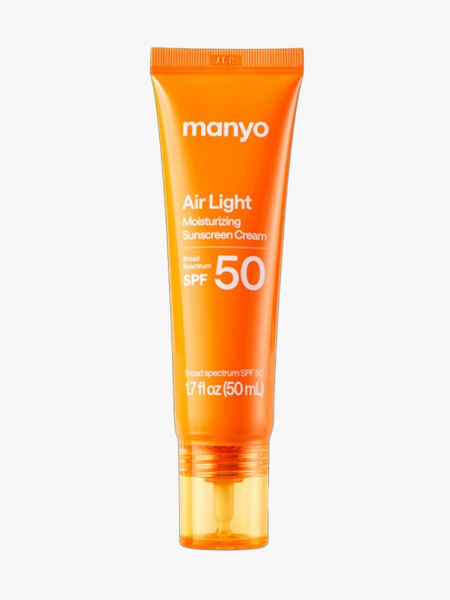
Best for Combination Skin: Manyo Air Light Moisturizing Sunscreen SPF 50
 Save to wishlist
Manyo
Air Light Moisturizing Sunscreen Cream SPF 50
Amazon
Han applying the Manyo Air Light Moisturizing Sunscreen SPF 50
Sarah Han
Why we love it: Think of the lightest sunscreen you've ever applied. Manyo's Air Light Moisturizing Sunscreen SPF 50 is perhaps even lighter. It's not quite an ultra-fluid serum, but trust us when we say you won't feel a thing once this featherweight formula is slathered on. Apart from the usual chemical filter suspects, ingredient enthusiasts will spot something less common: ensulizole. If you aren't familiar, this FDA-approved UV filter is water-soluble, so it lends well to a lightweight, non-greasy finish. Because it only protects against UVB rays, it has to be combined with other filters—here, those are homosalate, octisalate, and octocrylene—to provide the necessary broad-spectrum protection. Another standout in this formula is tranexamic acid, which helps restrict UV-induced melanin synthesis and, therefore, is a rockstar at brightening and fading dark spots. We also appreciate the thin nozzle, which helps us dispense perfectly even lines of product (hey, two-finger rule) sans any runny mess.
Tester feedback from Han
LargeChevron
“Korean sunscreens are so good that it's honestly hard for one to stand out from the rest. (I try a lot of them, ok?) However, thanks to the US banning sales of non-FDA-approved sunscreen filters, our options have gotten a bit more interesting. I've been testing this Manyo Air Light SPF for a few months, thanks to Best of Beauty testing, and have been smitten with it ever since. It has that serum-y texture I love in my sunscreens that melts into my skin super quickly—because I can't be bothered to rub in sunscreen for 15 seconds when there are faster options! It's super breathable and layers beautifully without a trace of pilling.” —Sarah Han, commerce editor
More to know
LargeChevron
- Sunscreen type: chemical
- UV filters: ensulizole (2.5%), homosalate (5%), octisalate (4.5%), octocrylene (5%)
- Noteworthy ingredients: tranexamic acid, niacinamide, vitamin E
- Who it's for: everyone, especially those with combo or oily skin
- Fragrance-free: yes
- Water-resistant: no
Best for Dry Skin: Innisfree Daily UV Defense Sunscreen SPF 50+ PA++++
 Save to wishlist
Innisfree
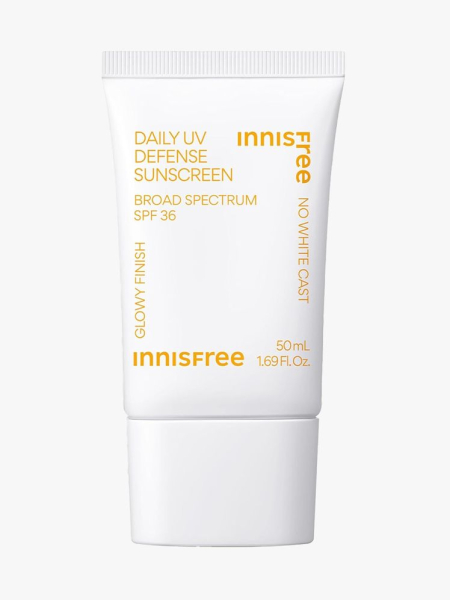
Daily UV Defense Sunscreen Lotion SPF 50+ PA++++
Amazon
Sephora
Allure contributing commerce writer Christa Joanna Lee applying the Innisfree Daily UV Defense Sunscreen SPF 50+ PA++++
Christa Joanna Lee
Why we love it: Well before this most recent K-beauty wave we're riding, Innisfree skin care has been a consistent favorite of ours, and their sunscreens have been in our sun-care routines for years. In fact, when we thought the Daily UV Defense Sunscreen couldn't get any better, the brand upped the SPF protection from the original 36 to 50. (As a reminder, SPF 50 protects skin against 98% of UVB rays, whereas SPF 30 protects against 97%.)
Hee Jin Kim, MD, a board-certified dermatologist based in Fort Lee, New Jersey, explains Daily UV Defense's popularity like this: “It’s the chemical sunscreen I reach for when patients want something they’ll actually wear every day—it disappears into skin and sits beautifully under makeup." No white cast, no pore clogging, and no pilling. But that's not all. "This formula leaves a hydrating, glowy finish while providing maximum UVA coverage, making it the natural pick when the goal is radiance, not just protection. For those unaware, the PA++++ rating refers to the highest amount of UVA protection possible. The scale ranges from one to four pluses.
P.S. The mineral Daily UV Defense sunscreen is just as good—in fact, it earned a 2025 Best of Beauty Award in the Clean category! “As someone with mild rosacea, I love anything that neutralizes redness; when it dries down, it doesn’t leave a greasy film or chalky residue, meaning it doesn’t get in the way or react funny with anything you layer on top of it,” content director Sophia Panych said.
Tester feedback from contributing commerce writer Christa Joanna Lee
LargeChevron
“Just when I thought Innisfree’s Daily UV Defense Sunscreen SPF 36 had checked every box, the brand gave it an SPF boost. This newer version bumps the protection up to SPF 50+ (which means more UVB protection—not a free pass to skip reapplication, sorry!). Like its predecessor, it disappears into skin in seconds with zero chalkiness or greasy residue. It’s so quick and easy to rub in that it’s become my go-to sunscreen for my body, too. My dry, sensitive skin drinks it up. I do wish it came in a huge pump, but that’s intentional with K-beauty brands—they love making sunscreens portable enough that you’ll actually toss them in your bag and reapply throughout the day.” —Christa Joanna Lee, contributing commerce writer
More to know
LargeChevron
- Sunscreen type: chemical
- UV filters: avobenzone (2.5%), homosalate (7%), octisalate (4.3%)
- Noteworthy ingredients: green tea, sunflower seed oil, cica
- Who it's for: everyone, especially those with dry skin
- Fragrance-free: no
- Water-resistant: no
Best Plumping: Medicube No Cast Just Glow Collagen Sunscreen SPF 50
 Save to wishlist
Medicube
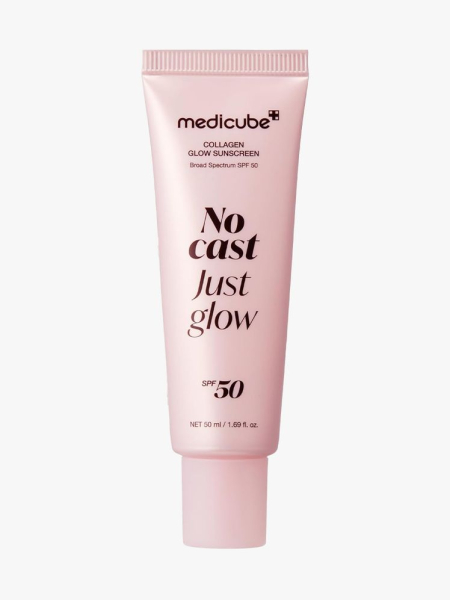
No Cast Just Glow Collagen Sunscreen SPF 50
Amazon
Allure managing editor Alessandra Foresto applying the Medicube No Cast Just Glow Collagen Sunscreen
Alessandra Foresto
Why we love it: There are a lot of K-beauty sunscreens out there, but when Allure’s resident K-beauty expert said she’d found the “glowiest sunscreen ever,” we immediately took note. Enter Medicube’s No Cast Just Glow Collagen Sunscreen SPF 50—a chemical sunscreen that’s all about protection and radiance, without any chalkiness in sight. It’s especially great for dull, tired-looking skin thanks to a skincare-forward lineup. Niacinamide helps visibly brighten and even tone, while hyaluronic acid boosts hydration so skin looks plumper and fresher, not flat or greasy. Collagen and peptides give skin that softly cushioned, lit-from-within finish, and soothing Centella asiatica (cica) helps soothe skin. The result is a broad-spectrum SPF that delivers protection and endless glow, so your highlighter can take the day off.
Tester feedback from managing editor Alessandra Foresto
LargeChevron
“Like a good beauty editor, sunscreen is not a step I skip even on the darkest, rainiest days. I like this Medicube SPF because it's light and absorbs quickly but still feels moisturizing, plus it has a very subtle radiant finish. Unlike other sunscreens, it doesn't leave a white cast behind and it also doesn't feel thick and sticky on my face. But, most importantly for me, it does not make my makeup pill. I use it as the last step in my moisturizing routine every morning, after a hyaluronic acid serum and a moisturizing cream, and before concealer and foundation.” —Alessandra Foresto, managing editor
More to know
LargeChevron
- Sunscreen type: chemical
- UV filters: 13.6% homosalate, 9% octocrylene, 4.5% octisalate, 2.7% avobenzone
- Noteworthy ingredients: hyaluronic acid, niacinamide, ceramides, collagen, peptides, Centella asiatica
- Who it's for: everyone, especially those with dry or dull skin
- Fragrance-free: yes
- Water-resistant: no
Best Sunscreen Stick: Abib Airy Sunstick SPF 50+
 Save to wishlist
Abib
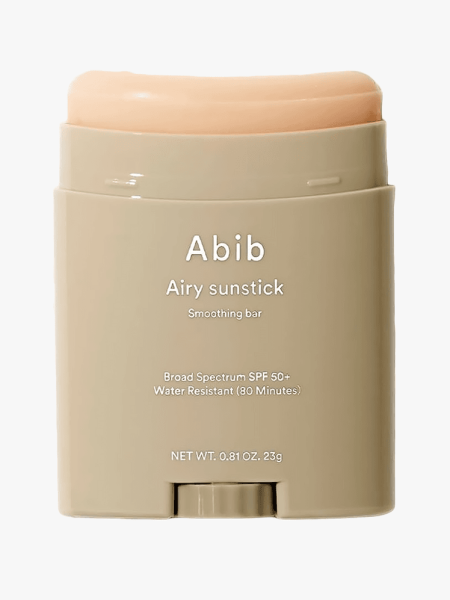
Airy Sunstick
Amazon
Yesstyle
Han applying the Abib Airy Sunstick SPF 50+
Sarah Han
Why we love it: Sunscreen reapplication is often easier said than done. We all know we're supposed to reapply every two hours, but if you're wearing makeup, slathering on a layer of sunscreen could mess up your meticulous base. Abib's Airy Sunstick is our top K-beauty sunscreen stick for a few reasons: The applicator is curved and better follows the contours of your face, and in particular, your cheekbones; it goes on clear and stays that way; it's infused with soothing ingredients, such as allantoin and ectoin, that Abib is widely known for. If your eyes are especially sensitive, a solid sunscreen could help prevent stinging—or, at the very least, allow you to double up on protection for this fragile, photoaging-susceptible area. Swipe and go: Just make sure you're passing back and forth a few times over every area for maximum protection. (Once is not enough, my friends!)
Tester feedback from Han
LargeChevron
“I'm on a journey of training myself to reapply sunscreen more often. I used to detest sunscreen sticks, but for the days I wear makeup (which is often), I'm giving them a shot. (Sprays aren't my thing, partially because I'm afraid they'll sting my eyes, and I haven't found an elegant enough SPF cushion yet.) For sticks, Abib's comes out on top so far, largely due to its wide, curved applicator. It hugs the contours of my cheeks, forehead, and chin, unlike other 'straight' bars, which makes application that much more pleasant/seamless. It's also clear from the very start, so I don't need any additional rubbing—no hands, ma! It does leave me a little dewier than before—especially since I do multiple passes per face area, which is vital when it comes to getting adequate protection from sticks—but not up to a point where I mind.” —Sarah Han, commerce editor
More to know
LargeChevron
- Sunscreen type: chemical
- UV filters: 9.5% homosalate, 5% octocrylene, 4.5% octisalate, 3% avobenzone
- Noteworthy ingredients: ectoin, sunflower seed oil, allantoin
- Who it’s for: anyone who wants an easy way to reapply sunscreen
- Fragrance-free: yes
- Water-resistant: yes, up to 80 minutes
Best Dewy Finish: Belif Dew Guard Glow Boost Serum SPF 40
 Save to wishlist
Belif
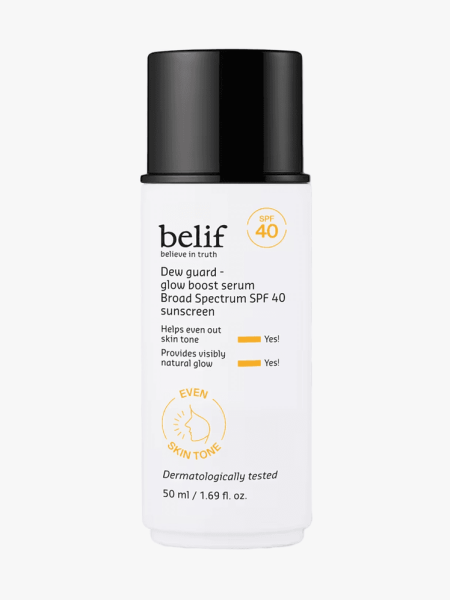
Dew Guard Glow Boost Serum SPF 40
Amazon
Ulta Beauty
Allure former associate beauty editor Annie Blay-Tettey applying the Belif Dew Guard Glow Boost Serum SPF 40
Annie Blay-Tettey
Why we love it: Dry, dull skin? We don't know her—and Belif's Dew Guard Glow Boost Serum SPF 40 doesn't either. PSA: Different weights of hyaluronic acid mean the active penetrates at different levels of your skin for more comprehensive, long-lasting hydration, and this chemical sunscreen has seven types going for it. That's not all: Niacinamide and vitamin C team up for one heck of a brightening duo. It wouldn't be a stretch (at all!) to call Dew Guard a “glow-up in a bottle.” While it's a great all-year-round formula—as are all of our picks—we'll definitely be reaching for this during the colder months when our skin is zapped of moisture.
More to know
LargeChevron
- Sunscreen type: chemical
- UV filters: avobenzone (2.7%), homosalate (9%), octisalate (4.5%), octocrylene (9%)
- Noteworthy ingredients: niacinamide, vitamin C, multi-7 hyaluronic acid
- Who it’s for: everyone, especially those with dull skin or uneven skin tone
- Fragrance-free: yes
- Water-resistant: no
Frequently Asked Questions
How are Korean sunscreens different from Western sunscreens?
One of the key differences between Western sunscreens and Korean sunscreens is their role in our perception of skin care, as Zion Ko Lamm, MD, a board-certified internal medicine doctor based in Charlotte, North Carolina, points out. Korean sunscreens are part of a skin-care lifestyle, defending against a broader range of long-term effects of the sun and promoting general skin health. On the other hand, Western sunscreens are formulated with necessity in mind, beginning and ending with sun protection.
Another difference is that no matter how much zinc oxide they contain, Korean mineral sunscreens are transparent on all skin tones, free of the telltale white cast that we often experience with non-Korean sunscreens. Plus, both chemical and mineral Korean sunscreens feature ingredients found in your favorite serums and moisturizers, like Centella asiatica, allantoin, ceramides, hyaluronic acid, and niacinamide. So when you apply Korean sunscreen to your face, you protect your skin from UVA and UVB rays and work in a layer of hydrating, brightening, and smoothing benefits.
Are Korean sunscreens better than Western sunscreens?
Depends on who you ask, but many would say yes. Why? "It's not that South Korea has something specifically unique that allows them to create better sunscreens," Toronto-based cosmetic chemist Stephen Ko previously told Allure. "They just have access to more sunscreen ingredients to work with."
Because the U.S. Food and Drug Administration (FDA) classifies sunscreen as a drug, its chemicals and components must undergo lengthy, formal drug approval processes, which results in limitations to the ingredients in Western formulas. In fact, "there hasn't been a new [chemical or mineral] approved for use in sunscreens in the U.S. since 1999," says Ko. This also allows Korean brands to incorporate SPF and skin care innovations into their formulas more swiftly, allowing for more state-of-the-art, sophisticated formulations (active ingredients include Tinosorb S, Uvinul A Plus, and Uvinul T 150).
In short, the U.S. is "terribly behind the rest of the world in approving sunscreens that are superior to those we have," Vivian Bucay, MD, a board-certified dermatologist based in San Antonio, Texas, previously told Allure. Even Congresswoman Alexandra Ocasio-Cortez agrees. If you're passionate about sunscreens like we are, she encourages people to contact their congressperson (especially if they sit on the Energy and Commerce Committee) and call upon them to "break through some of the regulatory barriers at the FDA" and "fund public research so that we can all enjoy the filters that develop out of the scientific process."
How should I choose a Korean sunscreen?
A lot of this depends on your personal preferences, just like any sunscreen produced in the US, Europe, Asia, etc. But if you look at Korean sunscreen packaging, you'll notice "PA" next to the SPF grades. While SPF measures the degree of UVB light protection, PA (Protection Grade of UVA) is all about UVA light and your protection from developing pigmentation, says Dr. Ko Lamm. She equates PA+++ to SPF 30 and recommends seeking out sunscreens with a minimum of each. "PA is based on the PPD test or the persistent pigmentation darkening test. It measures the multiple increases of UVA a person can theoretically be exposed to without tanning or darkening of the skin," Dr. Ko Lamm adds. "The PA system ranges from PA+ to PA++++; the maximum rating means it has a PPD value of 16." This means that while wearing PA++++ sunscreen, your skin can withstand 16 times more UVA radiation than it would without the sunscreen. So, until you exceed that hypothetical 16x UVA level, you won't start to tan or burn.
Meet the experts
- Vivian Bucay, MD, a board-certified dermatologist based at the Bucay Center for Dermatology and Aesthetics, based in San Antonio
- Claire Chang, MD, a board-certified dermatologist based in New York City
- Stephen Ko, a cosmetic chemist based in Toronto
- Zion Ko Lamm, MD, a board-certified internal medicine doctor based in Charlotte, North Carolina
- Hee Jin Kim, MD, a board-certified dermatologist based in Fort Lee, New Jersey
How we test and review products
When Allure tests a product, our editors look at it from every angle in an effort to best serve you. We review ingredients, scrutinize brand claims, and, when necessary, examine peer-reviewed scientific and medical studies. In addition to testing each and every product that’s included in each and every review, we rely on experts who shape their fields, including dermatology, cosmetic chemistry, and medicine, to help us vet the ingredients and formulas.
For our list of the best Korean sunscreens, we considered each product’s performance across five primary categories: product ingredients, efficacy, product wear, and benefits. Every product was determined to have excelled in each category by our editorial team, which is composed of in-house writers and editors as well as contributors—along with special consideration from dermatologists. To learn more information on our reporting and testing processes, read our complete reviews process and methodology page.
Our staff and testers
A beauty product is a personal purchase. You might be searching for a face cream to address persistent dryness or a new nail product to add to your Sunday self-care routine; you may simply be browsing around for the latest launches to hit the hair market. No matter what you seek or your individual needs and concerns, Allure wants to ensure that you love anything we recommend in our stories. We believe that having a diverse team of writers and editors—in addition to the wide range of outside testers and industry experts we regularly call upon—is essential to reaching that goal.
After all, can we really say a skin-care product is the "best" for people over 50 if the only testers we’ve solicited opinions from folks who have yet to hit 30? Can we honestly deem a high-end diffuser worthy of your hard-earned cash if it’s never been tested on curls? We’re proud that our staff spans a wide range of ages, skin tones, hair textures, genders, and backgrounds, which means that we are able to fairly assess any beauty product that comes into the beauty closet.
Leave a Reply